

Parish Church of Saint James the Greater, Puente la Reina
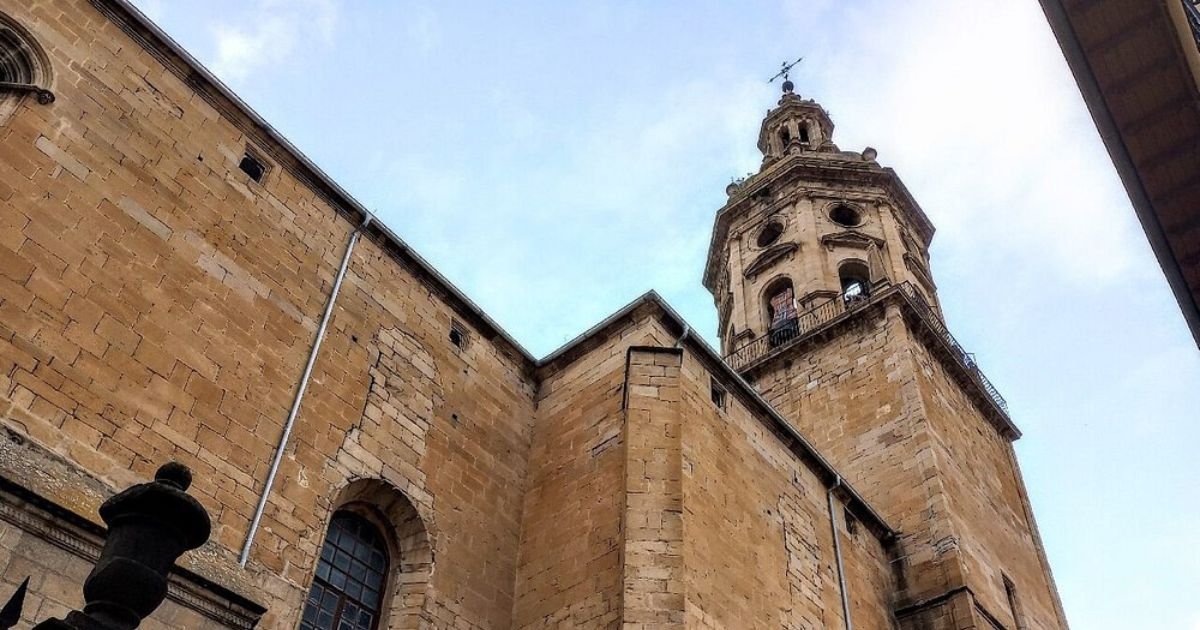
The Church of Saint James in Puente la Reina, together with the Church of San Pedro, is a major parish church for Catholics. This church is a 16th-century building in Late Gothic style, but has sections dating back to the 12th-century Romanesque church. The bell tower and the altarpieces inside are 18th-century Baroque. It is located in the heart of the old town, on Calle Mayor in the village of Puente la Reina, Navarra.
The church sits on the route of the Camino de Santiago Frances, which passes through it.
Architecture of the Church of Saint James in Puente la Reina
12th century
Architecture in the 12th century was a fascinating blend of styles, reflected in the Romanesque church of that period. The old walls still stand, showing a wide nave that was probably divided into three sections at first. The 16th-century construction rises on these walls, keeping the two Romanesque doorways, one at the main entrance and another facing Calle Mayor. The main doorway is impressive, with a round arch decorated with five richly ornamented archivolts. By contrast, the side doorway is simpler, with three archivolts and little sculpture.
16th century
The 16th-century construction fits very well with the Romanesque walls, extending the space with a transept and east end, resulting in a large church. There is a clear distinction between the medieval wall, made of dark grey stone, and the modern wall, in a lighter, yellowish tone. The project began in 1543 and finished in 1566, under the supervision of two stonemasons from Guipuzcoa: Martin de Oyarzabal and Lazaro de Iriarte. The church, of excellent stonework quality, is quite spacious, with a Latin-cross plan made up of three bays and a polygonal east end. The first two bays are separated by internal buttresses. Above the first bay is the choir, while in the second, between the buttresses, there are two chapels. These buttresses are rounded at the ends like half-columns, with bases and mouldings similar to toothed capitals at the ends. The same moulding style is seen on the arch leading to the east end. The roofs are formed by star-ribbed vaults with ogee curves, in various designs typical of 16th-century Spanish Late Gothic, and their ribs rest on semicircular corbels decorated with plant motifs. The choir was completed in 1575, raised over three depressed arches, the central one being the largest and supported by two freestanding fluted columns and two more attached to the wall, with capitals decorated with plant motifs. On the staircase, on the pillar where the handrail begins, a lion holding a cartouche can be seen.
18th century
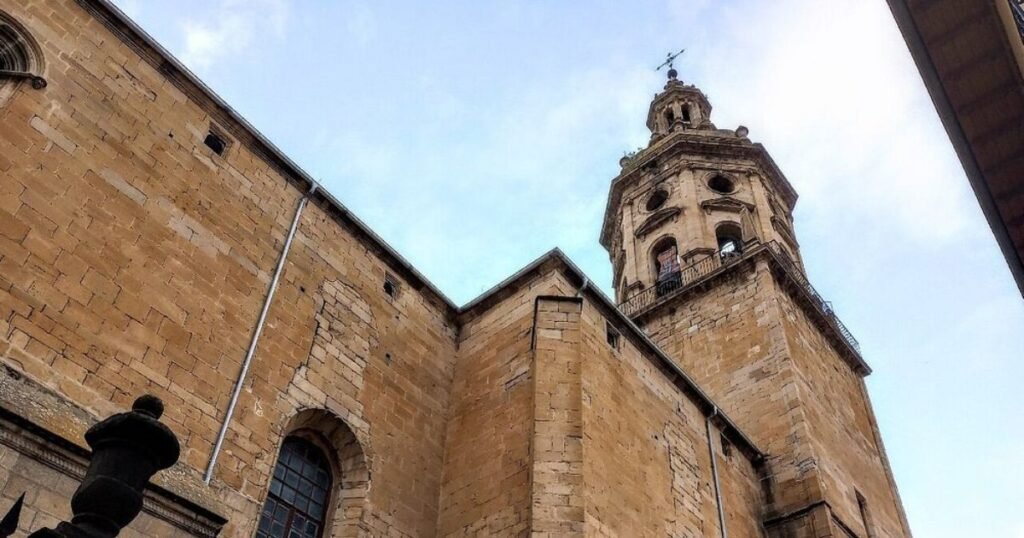
The tower stands next to the east end, on the Epistle side. This magnificent structure begins with a prismatic base dating from the 16th century, divided into two distinct sections. The tower’s crowning feature, an essential part of its design, was built between 1776 and 1778. This work was carried out in an elegant late Baroque style, marked by sober lines with Classical elements. It was built by the architect Santos Angel de Ochandategui, a collaborator of the famous Neoclassical architect Ventura Rodriguez.
The upper part of the tower is an octagonal body carefully articulated with Ionic pilasters, built using a technique known as pointed ashlar. Round arches for the bells open between these pilasters. These arches are decorated with alternating triangular and curved pediments, above which are oculi, round openings. All of this is topped with a full entablature that gives the structure a very defined finish.
A stone balustrade also encircles the structure and leads to a ribbed dome extending directly from the octagonal bell chamber, keeping the design consistent by also including matching oculi. At the very top stands a lantern articulated with a Corinthian order, topped with a small dome. Elegant stone urns have been placed at the corners of the tower, adding a decorative touch to the structure.
This design seems to be inspired by the Baroque towers of the La Rioja region, such as the tower of the Church of Santa Maria la Redonda, found in Logrono. Inside the tower is a square-plan room covered by a tierceron vault with curved ribs. This room gives access to a spiral staircase leading to the belfry, allowing access to the bells. This room may have served as a sacristy before the current sacristy was built.
Romanesque doorways of the Church of Saint James, Puente la Reina
Main doorway, 13th century
The main door of this beautiful building, which opens directly onto Calle Mayor, dates from the early 13th century. This impressive entrance is marked by its great wealth of sculpture, although unfortunately it is in an advanced state of deterioration. This wear makes it difficult to clearly identify the subjects depicted in the carving. However, some scenes can be made out, including demons symbolising various sins, figures locked in combat, winged angels, two crossed fish, and a knight fighting a dragon, among others.
On the keystones of the door, the upper points where the arch meets, various images can be made out, ranging from the Agnus Dei, representing the Lamb of God, to a depiction of God the Father giving a blessing. An angel resting on a cloud and a head appearing over a crescent moon can also be seen. It is worth noting that the entrance lacks a tympanum, and its inner arch is lobed in shape, similar to the doorways of other churches, such as that of the Church of San Pedro de la Rua in Estella and the Church of Saint Romanus in Cirauqui, although the latter have pointed arches.
Among the eight lobes decorating the entrance are angels focusing their attention on the figure of Christ. The impost blocks, the mouldings sitting above the capitals, are decorated with plant motifs, while the capitals themselves, which show notable wear, feature figurative scenes that are hard to identify. The decoration extends to the wall fronts, where harpies and winged lions can be seen. It is worth noting that the jamb pillars have recently been restored, giving an idea of the care taken to preserve this magnificent work.
On either side of the main doorway are two large sculptural groups. One shows a man driving his sword into a lion, while the other depicts an intense combat scene. Overall, the main doorway appears to have been inspired by that of the Church of San Miguel in Estella, with notable similarities in design and style.
The doorway at the foot of the building is somewhat older, dating from the 12th century, and its design is much simpler than the main doorway. The archivolts of this entrance rest on small columns, each with capitals decorated with leaves featuring small balls at the corners. In addition, each side of the entrance has a fourth capital set on cut columns. In the tympanum of this doorway, the upper section completing the space above the door, a Chi-Rho symbol can be seen, a Christian symbol representing Jesus Christ and common in Romanesque architecture.
Gothic images: Santiago beltza and Saint Bartholomew
Inside the church, in the second bay of the building, an image of Saint James the Pilgrim can be seen, popularly known as Santiago beltza, meaning “black” in the Basque language due to its darker skin tone. This figure is a magnificent Gothic carving dating from the second half of the 14th century, originally located on the main altar of the medieval church. Santiago beltza is dressed in the typical garments worn by pilgrims travelling to the Cathedral of Santiago de Compostela in Santiago de Compostela, including a staff held in one hand and a hat decorated with scallop shells symbolising his pilgrimage.
Saint James’s face shows distinctive Gothic features typical of the period; his eyebrows are arched, his eyes are almond-shaped and elongated, and his mouth is slightly open, giving him a lively, dynamic expression. He also has a carefully worked beard showing geometric waves. The image of Saint James forms a fairly straight-edged block, fitting perfectly within the width of the tree trunk from which it was carved. As for his robes, both the tunic and the cloak are covered with gilding applied in the 16th century, while the lining of the cloak has a brownish colour that contrasts with the shine of the gilding.
On the opposite wall of the same church is another masterpiece of 14th-century Gothic sculpture. This image, depicting Saint Bartholomew, also shows a style similar to that of Santiago beltza. This figure is made of polychrome stone, though the right hand and the knife it holds have been restored and replaced with wooden pieces. Unlike the image of Saint James, Saint Bartholomew has a more dynamic, active pose; he appears to be striding forward with his knee, and his cloak billows forward, bringing the lines of his figure to life.
Saint Bartholomew’s face, like that of Saint James, is beautifully worked, with arched eyebrows, almond-shaped eyes and a slightly open mouth adding to its intense expression. Saint Bartholomew’s beard, separated from the neck, has also been carved with great attention to detail, using flowing lines that give it a highly realistic, elaborate look. Both images bear witness to the artistic talent of the Gothic period and reflect the devotion and attention to detail dedicated to religious sculpture at that time in history.
Main altarpiece of the Church of Saint James in Puente la Reina
The altarpiece in the church’s presbytery was commissioned in 1665 from two talented Navarrese masters known as Gabriel de Berastegui and Jose de Huici. This altarpiece is an impressive example of the Baroque style, marked by its ornamental richness and attention to detail. In this magnificent altarpiece, the figurative elements are beautifully polychrome, meaning they are painted in a variety of vivid colours, while the structural and ornamental components are delicately covered in gilding, giving them a special shine. The altarpiece’s structure is arranged in three horizontal levels and divided into three vertical sections.
On the lower level, also known as the predella, a tabernacle is set at the centre, built within a small shrine in 20th-century Neo-Baroque style. This tabernacle is flanked on both sides by two panels decorated with naturalistic relief work that is truly inventive. These reliefs depict two important moments related to the figure of the Virgin; one shows the apparition of the Virgin to Saint James in Zaragoza, while the other illustrates the beheading of Saint James in Jerusalem. All of this is framed by four finials richly covered in ornamentation. The two central finials are decorated with the famous Cross of Saint James surrounded by scallop shells. Behind these panels are hidden reliquary cabinets on each side; these cabinets open so the faithful can venerate the relics they contain, particularly on All Saints’ Day.
On the middle level of the altarpiece, the side sections are decorated with two pairs of giant-order Corinthian columns, which support a very pronounced frieze featuring triglyphs and clusters of fleshy leaves. In the central section stands an imposing figure of Saint James the Pilgrim, installed around 1770. This figure stands out for its excellent quality and is thought to have been made in a Madrid workshop. It is set within a niche supported by Corinthian columns, surrounded by garlands holding up a broken curved pediment from which gilded rays radiate, with the emblematic Cross of Saint James at the centre. To the left and right of this central figure are the images of Saint Sebastian and Saint Roch, made in 1742, most likely by the artist Francisco Barona. These images stand on bases decorated with foliage and are set beneath distinctive plaques with plant ornamentation, further enhancing their beauty.
On the upper level of the altarpiece, known as the attic, the sections are defined by pilasters with sloped sides and a curved finish. At the centre is a coat of arms set on a plant-motif cartouche, flanked on both sides by two more coats of arms representing the town. At the very top of the altarpiece stand the Cross of Saint James and the scallop shell, completing this spectacular work. This upper level contains a Crucifixion dating from the second third of the 16th century, along with two Baroque images depicting the Virgin and Saint John, adding an even deeper touch of spirituality and tradition to this extraordinary piece of sacred art.