Galician Mayors Invite Pope Leo XIV to Walk the Camino Frances in the 2027 Compostela Holy Year
Eleven Galician mayors from the Association of Municipalities of the Camino Frances have formally invited Pope Leo XIV to walk a stretch of the Camino de Santiago in Galicia on the occasion of the upcoming 2027 Compostela Holy Year, when the Holy Door of Cathedral of Santiago de Compostela will once again be opened.
The delegation, accompanied by representatives of the Camino de Santiago Association, Main Street of Europe, presented the pontiff with a letter of invitation during a general audience in St Peter’s Square, together with two classic symbols of the Jacobean pilgrimage: a pilgrim’s staff and a Sargadelos scallop shell, carefully chosen to represent Galician tradition and the spirit of the Camino.
According to Arzúa’s Tourism Councillor, Begña Balado, and the commissioner of the “Almas del Camino” (“Souls of the Camino”) programme, José Tono Martínez, the Pope appeared «surprised» by the gesture and remarked that he “might” consider joining the pilgrims for a short stretch of the route as the 2027 Holy Year approaches.
The Camino Frances Association in Galicia: Eleven Municipalities and Eleven Mayors United Around the Camino de Santiago
The Association of Galician Municipalities of the Camino Frances brings together the town councils through which the final stages of the Camino Frances pass in Galicia, from the entrance at O Cebreiro to the gates of Santiago de Compostela. They are eleven municipalities united by a single Jacobean route, by the shared management of services and by a common strategy for tourism and cultural promotion.
The municipalities that make up the association — all of them directly linked to the Camino de Santiago Frances in Galicia — are:
- Pedrafita do Cebreiro – Mayor: José Luis Raposo Magdalena, head of the municipality that is home to the legendary village of O Cebreiro, the gateway to the Camino Frances in Galicia and one of the most iconic landscapes for peregrinos.
- Triacastela – Mayor: Olga Iglesias Fontal, well known for her defence of the Camino Frances and her involvement in projects that showcase the Jacobean route.
- Samos – Mayor: Chus López, a nationalist mayor heading the municipality that is home to the historic Samos Monastery, one of the great spiritual landmarks of the Camino de Santiago.
- Sarria – Mayor: Claudio Garrido, the top authority in the municipality that has become established as the most popular starting point on the Camino Frances for those seeking to complete the final 100 kilometres to Santiago de Compostela.
- Paradela – Mayor: Montserrat Mulet, who succeeded long-serving mayor José Manuel Mato and symbolises a new stage of local government tied to rural areas and the Camino.
- Portomarín – Mayor: Pablo Rivas Folgueira, a young mayor governing a town renowned for its spectacular setting beside the reservoir and its fortress-church of Saint Nicholas.
- Monterroso – Mayor: Eloy Pérez Sindín, an agricultural engineer and mayor of one of the municipalities in the Ulloa region, a key stage between Portomarín and Palas de Rei.
- Palas de Rei – Mayor: Pablo José Taboada Camoira, a central figure in the territorial debate over the Altri industrial project, and representative of a municipality with a long Jacobean tradition.
- Melide – Mayor: José Manuel Pérez Penas, heading a town famous for its octopus, its crossroads of routes (French and Primitive) and its Romanesque heritage.
- Arzúa – Mayor: Xoán Xesús Carril, a nationalist mayor of a town famous for the Cheese Festival and for being the second-to-last major stop before reaching Santiago.
- O Pino – Mayor: Manuel Taboada Vigo, responsible for the last municipality on the Camino Frances before Santiago, home to well-known spots such as Arca and Santa Irene.
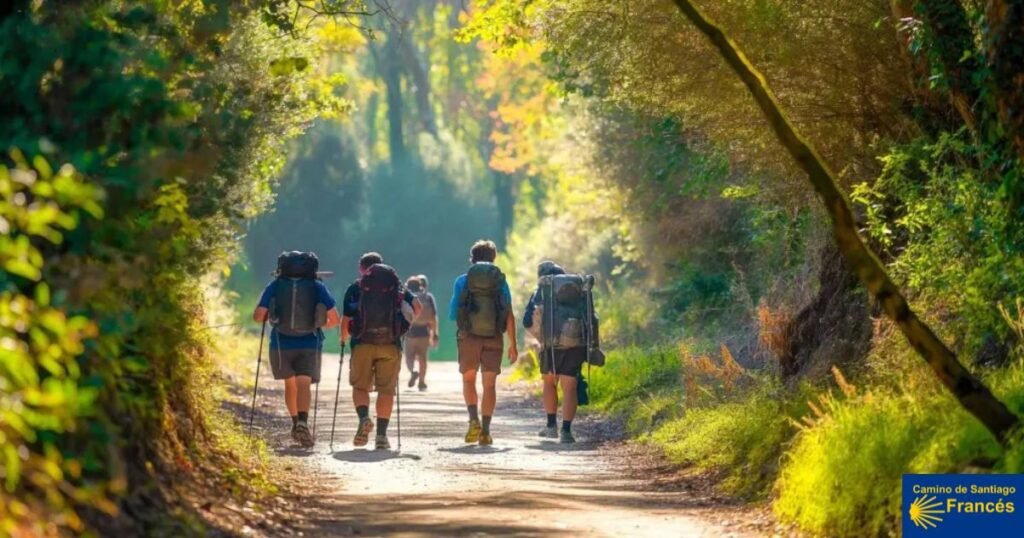
These eleven town councils together account for nearly 160 kilometres of the Camino Frances in Galicia, sustaining a rural area that depends, to a large extent, on the annual flow of thousands of international pilgrims.
Olga Iglesias, Begña Balado and the Shared Leadership of the Camino Frances
The letter presented to Pope Leo XIV is tied to the work of the Association of Galician Municipalities of the Camino Frances, which in recent years has been very actively led by the mayor of Triacastela, Olga Iglesias Fontal, and by Arzúa’s Tourism Councillor, Begña Balado.
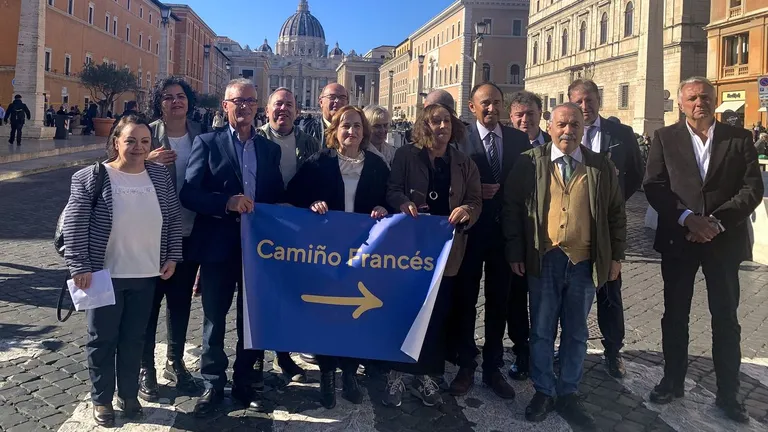
Olga Iglesias has chaired the association, driving coordination between the town councils, the defence of Jacobean heritage and fundraising — for example, through projects linked to Next Generation funds to improve the tourism sustainability of the Camino Frances.
Since late 2025, the chairmanship has passed to Begña Balado, who combines her role as Tourism Councillor in Arzúa with running the joint municipal body. Under her leadership, the association is strengthening joint promotion, the digitalisation of resources, and cultural projects such as “Almas del Camino”, of which she is one of the most visible faces.
“Almas del Camino”: A Cultural Project to Tell the Stories of the Camino de Santiago
The invitation to the Pope is part of the “Almas del Camino” programme, a cultural and audiovisual initiative driven by the Main Street of Europe Association, based in Molinaseca (Leon Province), working in close coordination with the Camino Frances Association in Galicia.
For months, this project has travelled the stages of the Camino, documenting the stories of hospitaleros, local residents, shopkeepers, pilgrims from all over the world, and the tangible and intangible heritage surrounding the Jacobean route. Its aim is to offer an in-depth look at the Camino Frances as:
- A leading spiritual and cultural route in Europe.
- An economic engine for small rural villages that depend largely on pilgrimage tourism.
- A space for interreligious and intercultural encounter, where believers, agnostics and people of different traditions come together.
The possible presence of Pope Leo XIV on one of these stretches would be, according to the initiative’s organisers, “a beacon of light and a universal message of unity, integration and peace”, as well as a promotional boost for the 2027 Compostela Holy Year and for the entire Camino de Santiago Frances.
A Camino de Santiago That Looks to the World: From the Vatican to Gaza
The invitation from the Galician mayors comes at a time when the pontiff has been strengthening his image as a leader concerned with international conflicts. Days before receiving the delegation from the Camino Frances Association, Pope Leo XIV met at the Vatican with the President of the Palestinian Authority, Mahmoud Abbas, to discuss the war and the humanitarian crisis in Gaza.
At that meeting, according to the Holy See, both agreed on the urgent need to provide aid to the civilian population of Gaza and on the need to move towards a two-state solution as the political horizon for the conflict between Israelis and Palestinians. This message fits with the idea that the Camino de Santiago — and, in particular, the Camino Frances in Galicia — could be presented to the world as a symbol of peace, dialogue and reconciliation.
Should the Pope ultimately accept the invitation from the eleven Galician mayors and walk even a few kilometres of the Camino Frances, the image of Pope Leo XIV walking among pilgrims through Arzúa, Melide, O Pino or any of the association’s municipalities would carry enormous symbolic weight:
- International reinforcement of the Camino de Santiago as a route of encounter and spirituality.
- Worldwide exposure for the small rural municipalities that keep the route alive.
- A direct message of support for peace and for peoples suffering war, consistent with his call to help Gaza and his advocacy for a two-state solution.
Camino Frances and the 2027 Holy Year: A Historic Opportunity for Galicia
The 2027 Compostela Holy Year will be celebrated when the feast day of Saint James the Apostle (25 July) once again falls on a Sunday, reopening the Holy Door of Santiago Cathedral and multiplying the influx of pilgrims from all over the world.
The eleven mayors of the Galician Camino Frances, coordinated through the association, want to make the most of this occasion to:
- Establish the Camino Frances in Galicia as the most internationally recognised Jacobean route.
- Strengthen tourism sustainability and heritage protection.
- Spread the values of hospitality, welcome and coexistence that define the experience of walking to Santiago de Compostela.
The possible presence of Pope Leo XIV, officially invited by these eleven mayors and backed by the “Almas del Camino” programme, is already shaping up to be one of the great milestones that could mark the Camino de Santiago Frances in 2027 and turn Galicia, once again, into a spiritual and cultural epicentre of Europe.